Balmory Moran II ’24, history, used to describe himself as a soccer player above all else. The soccer field and his team were where he felt most at home. In high school, an injury ended his hopes of playing at the collegiate level, and doubts about his future settled in until he met Joe Thompson, a professor of history and political science at Montgomery College (MC), and Andrew Nolan, teaching professor of history at UMBC. They instilled in him a passion for history, and their support helped him transfer to UMBC as a history major, where he learned not only about the past but also interpersonal and mentorship skills that he now puts to practice every day as a coach for the Latino Youth Development Program in Rockville, Maryland.
As a coach, Balmory imparts performance strategies and techniques to middle school and high school students in the program while also emphasizing essential team skills such as collaboration, active listening, empathy, and accountability, both on and off the field. This strategy led the team to win the league championship in fall 2025.
After years of coaching and time away from the classroom, Balmory is ready to balance soccer and the classroom once again as he begins applying to a master’s in social work. He credits his sister, Alexandra Moran ’15, social work, a current social worker, for the inspiration to join the field. Take it away, Balmory!
Q: What was your journey to UMBC?
A: I began my undergraduate experience at MC. I was a bit lost, and I didn’t know what I wanted to do, but Professor Thompson changed all that. I had a 200-level U.S. history class with him. He made our class so entertaining, enticing, and interesting at both a personal and an academic level. It really showed me that history didn’t have to be boring or slow.
After seeing how attentive I was in his classes, he encouraged me to pursue a degree in history. Professor Thompson showed me multiple examples of students in different fields of work with a history degree. It prompted me to take more history classes at MC, which laid the foundation for studying history at UMBC.
I made my way to UMBC after Professor Nolan visited MC multiple times to talk to students about life as a history major at UMBC and the careers it could lead to after graduation. He also explained the many ways UMBC would further nurture my academic aspirations. I was so involved with the history program at MC that it felt like a natural next step to continue my undergrad degree in history at UMBC.
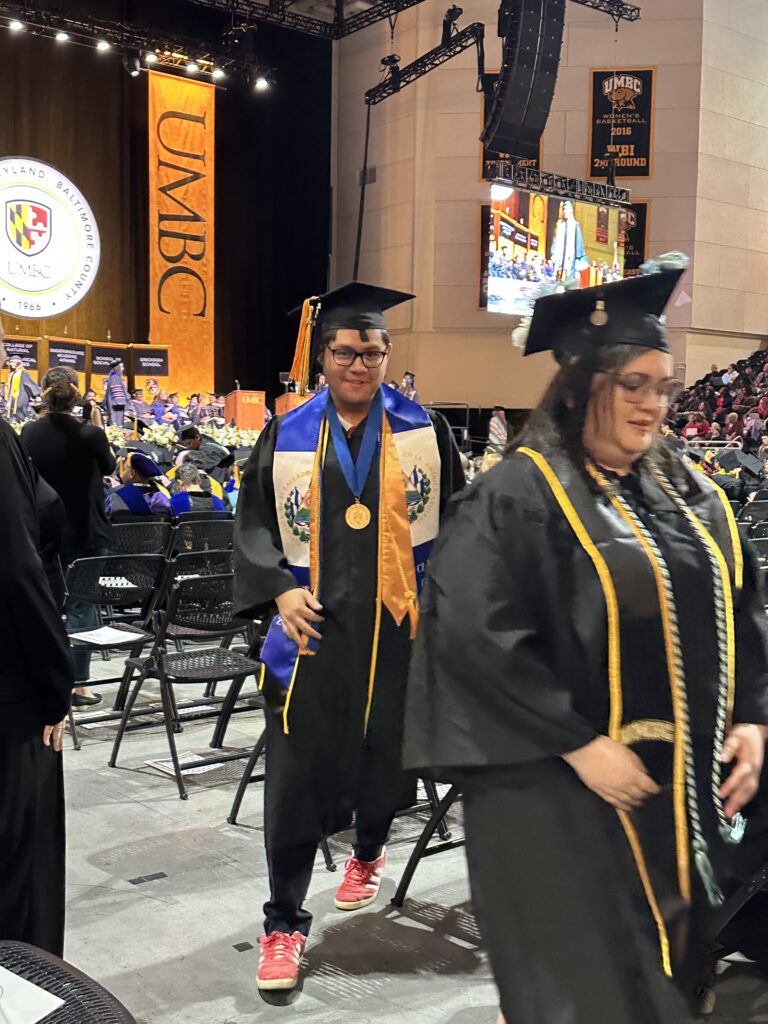
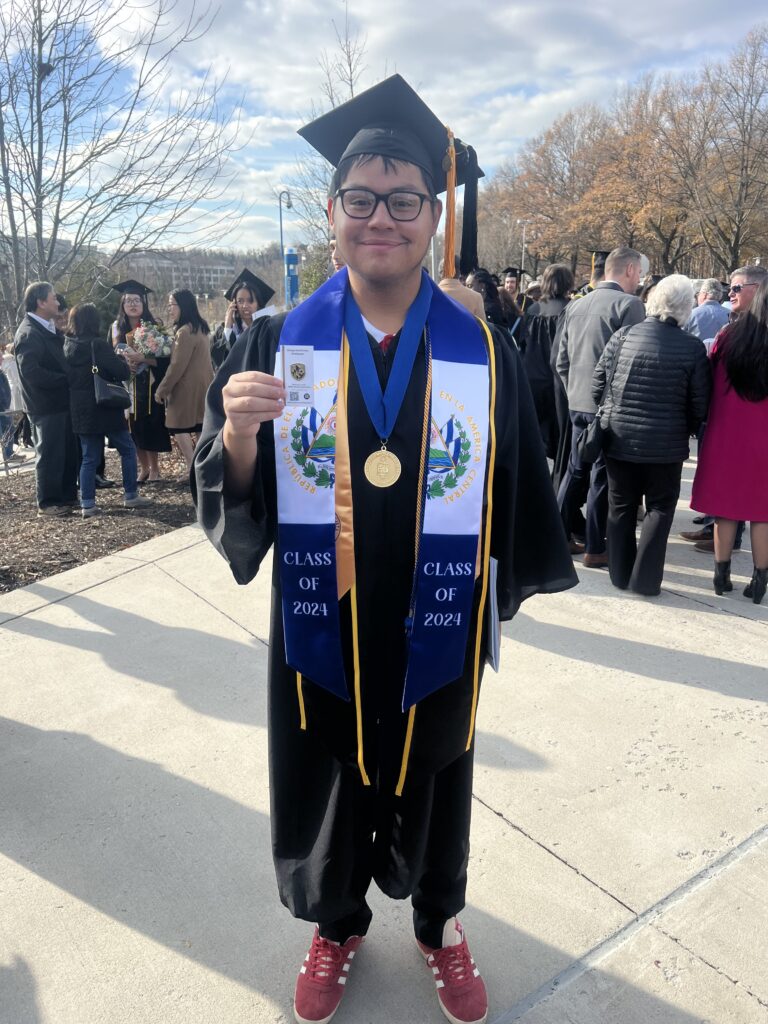 Moran at his 2024 graduation from UMBC.
Q: What was your experience studying history at UMBC?
A: Once at UMBC, I dove into the multitude of classes on aging, women’s studies, sociology, and, of course, history, which all helped me gain a better understanding and appreciation for the communities I grew up alongside. I learned that there was a history of pretty much everything, as long as there was some interest. So many people think history is just old people in wigs, but it’s everywhere, from political history to sports history. There is always a story to be told as long as someone is willing to listen and learn.
Q: Who in the UMBC community has inspired you or supported you?
A: The last two years have really pushed me to be the best version of myself in my work as well as my mentorship. I’ve learned from Melissa Blair, associate teaching professor of history, as well as other professors throughout the history department, how to approach different types of students. These lessons have helped me teach these young men right from wrong in ways that they can understand.
UMBC gave me the tools to be creative in how I tackle challenges and debates with my players. I guide players by equipping them with the tools to grow and improve, as Blair and other professors supported me in the classroom, rather than stepping in.
So many people think history is just old people in wigs, but it’s everywhere, from political history to sports history. There is always a story to be told as long as someone is willing to listen and learn. —Balmory Moran ’24
Q: Is there a concept you learned in your classes at UMBC that is applicable outside of the classroom?
A: The professors I had at UMBC showed me that there are many ways to get important information across that don’t feel like a lecture. They taught me how to be an effective problem-solver. These lessons were within a history class setup, but felt applicable to how I wanted to coach and mentor my players. So many people get the wrong idea when they hear the term “history degree.” It’s not just about curating museums and lecturing. It is also about what makes us who we are, helps us understand where we come from, and what values we hold onto.
* * * * *
UMBC’s greatest strength is its people. When people meet Retrievers and hear about the passion they bring, the relationships they create, the ways they support each other, and the commitment they have to inclusive excellence, they truly get a sense of our community. That’s what Meet a Retriever is all about.
Learn more about how UMBC can help you achieve your goals and the UMBC History Department’s programs and faculty.