NASA selects UMBC-led instrument to monitor lunar environment, support future Moon Base
NASA has selected a team led by UMBC to develop another critical environmental monitoring station for the lunar south pole, a key step toward establishing humanity’s first permanent outpost on the Moon.
The Lunar Environment Monitoring Station at the South Pole, or LEMS-SP, will serve as an autonomous sentinel at one of the most scientifically significant and resource-rich locations in the solar system. The instrument suite will measure volatile compounds released into the Moon’s thin atmosphere, detect impacts from tiny, high-speed particles striking the surface known as micrometeoroids, and sense ground motion with a highly sensitive seismometer. Together, these measurements will help researchers understand how volatiles are released and move through the lunar environment over time.
The selection marks UMBC’s growing leadership in lunar science and represents the fourth NASA lunar mission for principal investigator Mehdi Benna, a planetary scientist with UMBC’s Center for Space Sciences and Technology.
 Mehdi Benna (Courtesy of Benna)
“This selection is an exciting opportunity to take another important step toward establishing a sustained human presence on the Moon,” Benna says. “The lunar south pole contains deposits of water ice and other volatiles that hold important clues to the Moon’s history and could become essential resources for long-term human exploration.”
Building on success
The LEMS-SP announcement follows NASA’s 2024 selection of Benna’s original Lunar Environment Monitoring Station for the Artemis (LEMS-A) mission, making him one of few researchers leading multiple concurrent lunar investigations. LEMS-A is a candidate to be deployed during a crewed Artemis landing on the Moon, and it will operate for up to two years to monitor seismic activity and environmental conditions.
With LEMS-SP, Benna’s team expands on LEMS-A’s goals. The new instrument will investigate not just what volatile materials exist at the south pole, but how they migrate, how they are released into the lunar environment, and how that environment changes over time.
“What makes this mission particularly exciting is that we are moving beyond brief snapshots of the lunar environment toward continuous, long-term observations,” Benna says. “By combining multiple scientific measurements on a single autonomous platform, LEMS-SP will help us better understand the Moon as a dynamic world while providing critical knowledge for the safety and sustainability of future lunar exploration.”
The data LEMS-SP collects will additionally directly inform the design and placement of Moon Base infrastructure. Understanding the frequency of micrometeoroid strikes, the behavior of volatile compounds, and the patterns of moonquake activity will help engineers develop safer, more resilient habitats and equipment for astronauts.
Operating at the frontier
The collaborative mission brings together expertise from across the United States. The University of Maryland, College Park serves as the deputy principal investigator institution, with NASA’s Goddard Space Flight Center leading implementation. The University of Colorado and the University of Arizona will provide specialized sensors, while Morehead State University will handle telecommunications and mission operations. Additional co-investigator institutions include the Planetary Science Institute, the Applied Physics Laboratory at Johns Hopkins University, the University of Iowa, NASA’s Marshall Space Flight Center, and Princeton University.
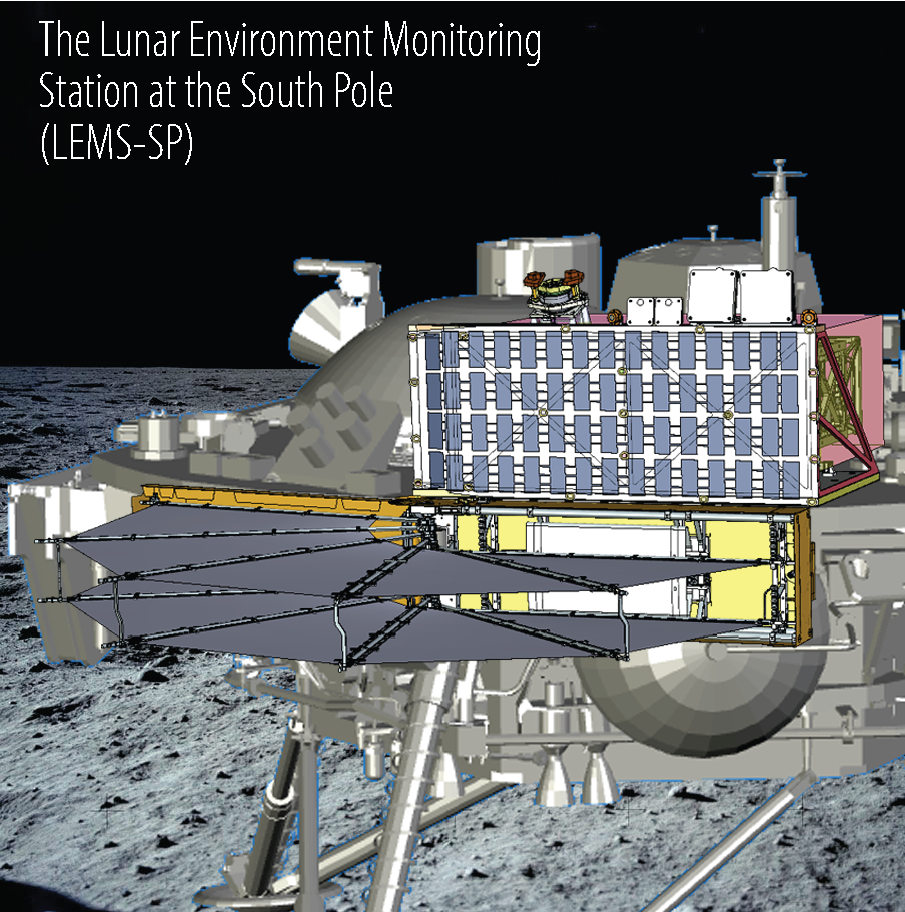 A rendering of the LEMS-SP instrument at the lunar south pole. (Courtesy of Mehdi Benna)
Benna is well-positioned to lead this massive new effort. He has authored more than 100 peer-reviewed scientific articles and delivered more than 200 presentations at international conferences. His research spans plasma physics and planetary dynamics, with previous instrument contributions to NASA’s MAVEN Mars mission and the Lunar Atmosphere and Dust Environment Explorer (LADEE) mission.
“UMBC continues to demonstrate that our researchers operate at the frontier of space exploration,” says Don Engel, director of CSST and associate professor of computer science and electrical engineering. “Dr. Benna’s leadership of not one, not two, but three current NASA lunar investigations underscores our commitment to advancing scientific understanding and supporting humanity’s return to the Moon.”
NASA announced the LEMS-SP selection as one of three new science investigations for its Moon Base program. The instruments will help the agency characterize the lunar environment and identify potential hazards before astronauts establish long-term surface operations.
The Moon Base program represents NASA’s most ambitious planetary science initiative in decades, with the goal of creating a sustainable human presence on the Moon by the end of the decade. Such a base would serve as a scientific research station, a testing ground for Mars exploration technologies, and potentially a staging point for deeper space missions.
Learn more about the research being done by more than 80 UMBC scientists and engineers in the Center for Space Sciences and Technology.